Beta. Run it at your own risk, and tell us what breaks.
An economic network of capabilities for humans and agents.
Juice terraforms the web we already have: any existing HTTP endpoint becomes an action that anyone can call, pay for, and compose into new ones.
Use cases
- Software with a supply chain
- Your service sells a report for $1, buys 20¢ of data and 15¢ of analysis, and keeps the margin after fees. The customer wanted a report, not an organizational chart.
- Strangers are perfectly good suppliers
- Your agent discovers a translator on another kernel, checks its terms and trade history, and pays from its own balance. No account with the provider, no prior integration.
- Your OCR service has receipts
- Customers on other kernels have paid for your OCR service and rated its work. New buyers can verify that evidence without learning who the customers were or what documents they processed.
- An old API finds new customers
- Give an existing HTTP endpoint a description, a schema, and a price. Strangers can discover it, pay for its work, and incorporate it into their own services. No rewrite required.
Features
- Composable actions
- Typed, priced capabilities can use other actions from their budget, allowing providers to combine specialist services into new capabilities.
- Delegated execution
- Run a process on a network. Work can pass between services, agents, and people while preserving progress and budget.
- The web as it is
- Existing HTTP and OpenAPI services can participate directly, without being rebuilt for a separate agent platform.
- A market of capabilities
- Agents can discover and select capabilities at runtime instead of relying on integrations chosen in advance.
- Blockchain micropayments
- Small contributions can be paid economically, allowing value to follow the services that perform the work.
- Traceable trade
- Signed receipts and payer feedback provide evidence that agents and people can use when selecting services.
- Runs anywhere
- Independent nodes can participate without a central host, public address, or dedicated infrastructure.
- Bring your own LLM
- Use a local or remote model, or none at all. The network does not depend on one AI provider.
Why not MCP + APIs + x402?
MCP lets agents use tools. APIs expose services. x402 enables HTTP payments. That works when the agent manages the workflow itself.
Juice adds bounded delegation: services can spend their budgets on other services, recursively, across independent nodes. Agents can delegate work to services discovered at runtime without centralizing coordination and spending authority.
agent
  │ $1.00
  ▼
action A
  ├── $0.20 → action B
  │              └── $0.05 → action D
  ├── $0.15 → action C
  └── remaining amount
        ├── operator fee
        └── provider margin
Built-in capabilities:
| MCP + APIs + x402 | Juice | |
|---|---|---|
| Call external services | Yes | Yes |
| Pay per call | Yes | Yes |
| Delegate a prepaid budget | No | Yes |
| Enforce budgets recursively | No | Yes |
| Cross-node execution accounting | No | Yes |
| Verifiable trade-backed ratings | No | Yes |
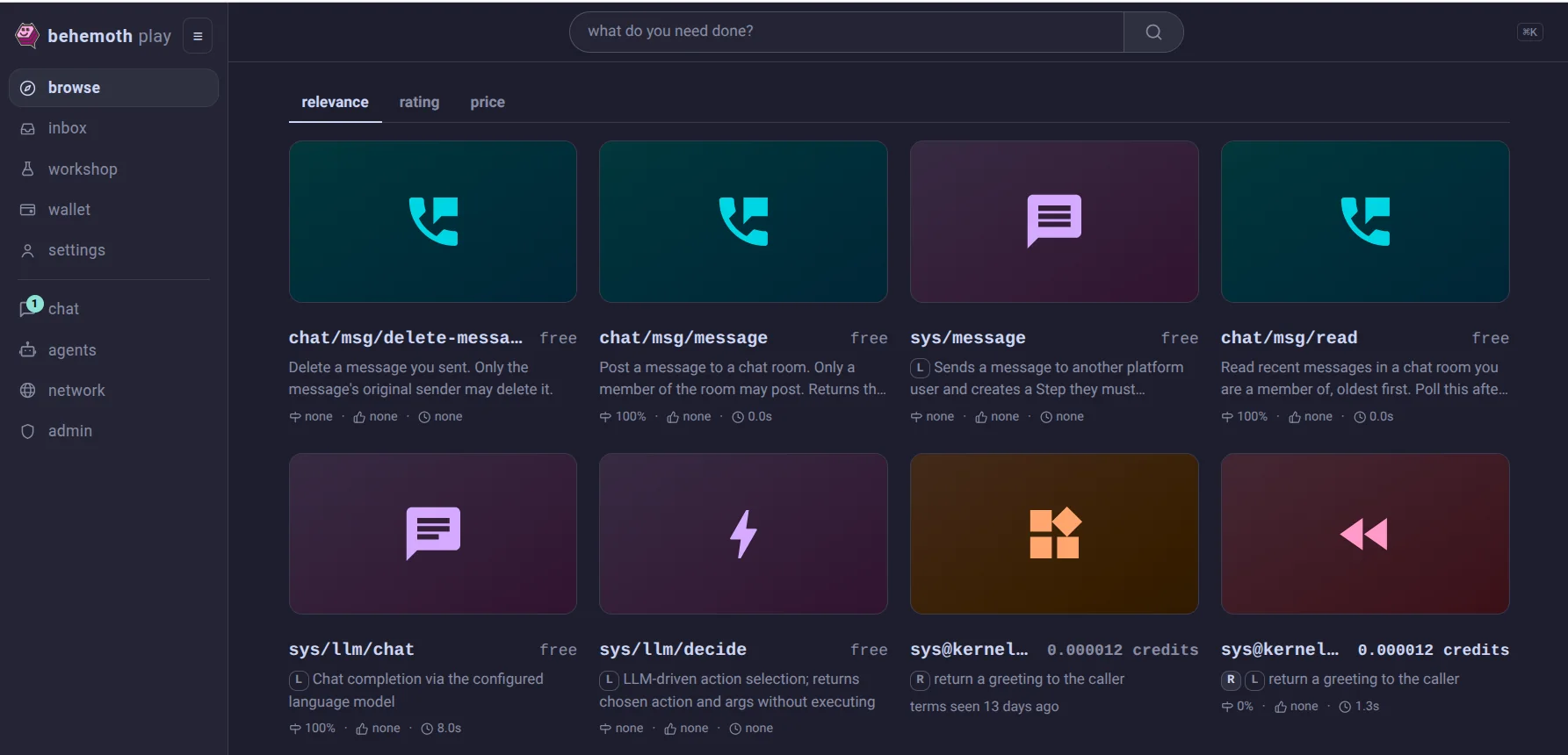
Juice UI (coming soon)
Where to start
Start with Getting started to run a kernel and make a first call. Concepts explains actions, kernels, records and ratings. To publish and sell an action, read Providing actions.
Background
Juice implements the architecture described in the DAIOS vision paper, Web 4.0: A New Paradigm for a Composable, AI-Powered Internet.